
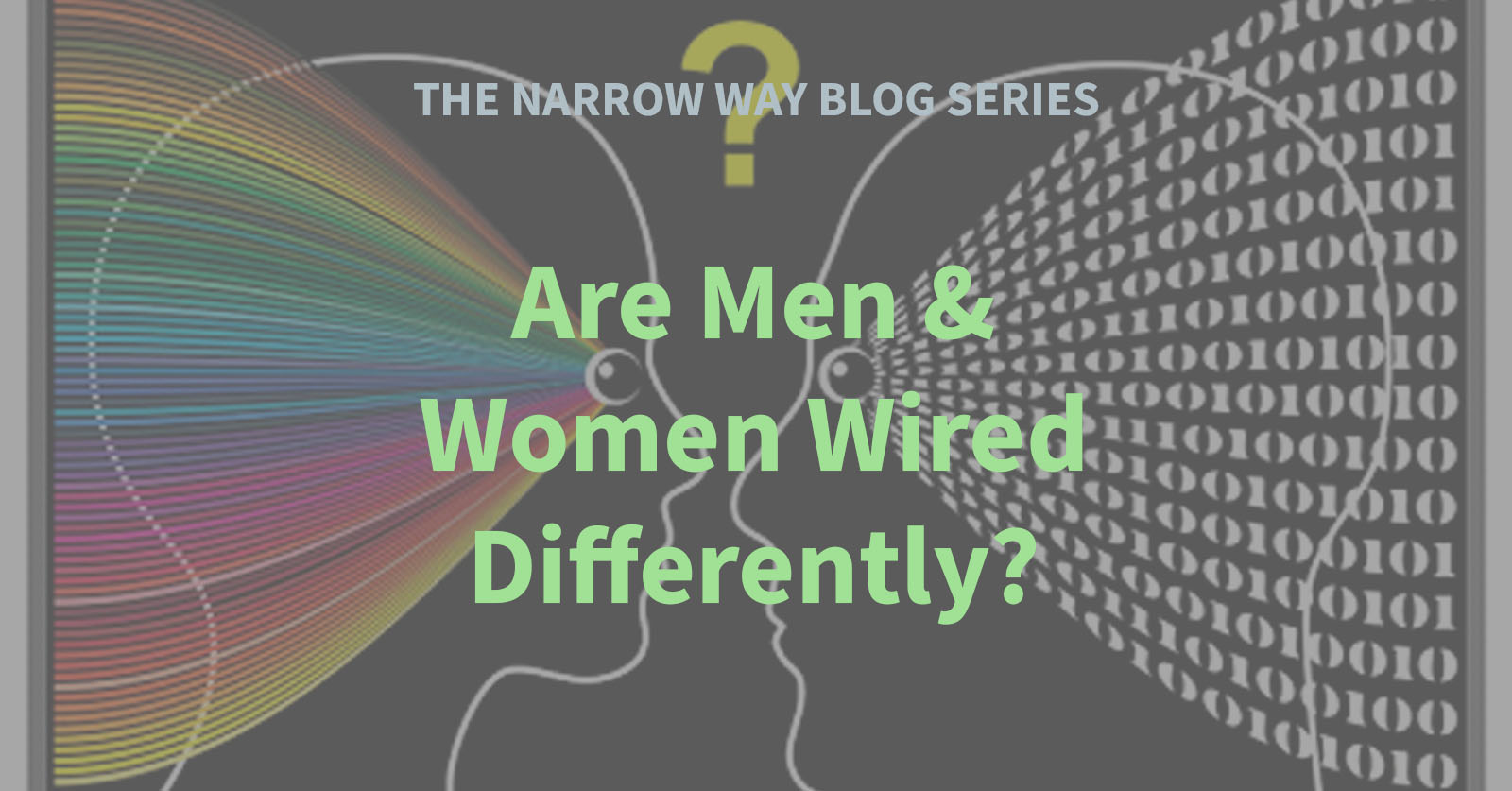
45 - Are Men & Women Wired Differently?
Anthropologist Margaret Mead once said, “The central problem of every society is to define appropriate roles for men.” Closely tied to this is our basic understanding of what it inherently means to be a man or a woman.
Consider with me some significant insights from the original Hebrew words found in the creation story.
Both men and women were created in God’s image. Even though scripture refers to God with male pronouns, and Jesus taught us to pray to God as our Father, the character of God encompasses the best of all that is masculine and feminine together. Each one of us, whether male or female, reflect the image of God. We are all made in the spiritual, relational, and representative image of God.
Nonetheless, we are distinct as male and female. Yes, anatomy is obviously different! But there are inner qualities and relational styles which differ as well—in other words, our masculinity and femininity. The key to discovering God’s creative intent is found in the very Hebrew words given to us in Genesis 1-4—words inspired by God himself.
First, let’s look at Genesis 1:26—27:
26 Then God said, “Let Us make mankind in Our image, according to Our likeness; and let them rule over the fish of the sea and over the birds of the sky and over the livestock and over all the earth, and over every crawling thing that crawls on the earth.” 27 So God created man in His own image, in the image of God He created him; male and female He created them. (NASB) (Italics added.)
The word used for “mankind” and “man” in this passage is adam. Even though that becomes the name of the first male, it actually has the much broader meaning of “humankind.” So in verse 27, it states that as he created humankind in his image, he created them as two distinct genders, male (zakar) and female (neqebah). Understanding these two words gives us some clarity on the distinctions between masculinity and femininity.1
In his helpful book Fully Alive: A Biblical Vision of Gender That Frees Men and Women to Live Beyond Stereotypes, Dr. Larry Crabb takes a deep dive into the Hebrew meaning of these words in the creation story. Keeping in mind our essence as image bearers of a relational Trinity, he teases out the unique characteristics found in these two words for male and female.
To begin with, neqebah refers to having been opened and now being entered. True femininity is relational and welcoming in nature, but not indiscriminately. She will receive only what is in line with the character and purposes of God. She is not a doormat with the word “Welcome” burned into it. She is made to be more like a modern door, one with a peep hole to see and discern who or what might be wanting to enter.
Zakar, on the other hand, means “to leave a mark, to have an impact.”2 The root of this word was eventually tagged on someone who assisted a king. A “zakar” was an advisor who had the king’s concerns at heart and reminded the king of what was important. So the truly masculine man wants to have an impact for the Kingdom of the One whose image he bears.
By God’s design, the masculine and feminine are meant to play equal and complementary roles in reflecting the image of God and advancing his concerns.
This does not mean that women were never meant to lead or have an impact. Nor does it excuse men from welcoming, receiving, and giving. It is simply how we are wired—what comes most naturally for us.
In this way, it is similar to our spiritual gifts. While the gifts I’ve been given by God are teaching, mercy, and encouragement, it does not mean that I play no role in evangelism or giving. Absolutely not. But given my giftset, I serve the Kingdom best in the roles that match my gifts. So too with our gender. Being feminine or masculine does not restrict our roles for the Kingdom, but guides us in the ways most in line with God’s design.
Please note: I am not applying this to the current Kingdom skirmishes over who has final say in the family. Egalitarians argue male headship was a result of the Fall and therefore spouses should rule the home equally. Complementarians state the headship was established in the Garden with the man receiving the crown. I offer no opinion on that matter. Regardless of where you land, neither the husband nor the wife should be controlling or manipulative.
But the essence of who we are as male and female is indeed instructive as we minister in this culture where feelings trump biology when it comes to understanding gender.
You may already have connected some dots between these Hebrew words and the act of sexual intimacy. That certainly is legitimate. Anatomically, women are designed to open and receive, while men enter and have an impact. So how do we know these words are about gender characteristics and not simply anatomy? After all, this may just be a description of genitalia. In the next article, we will look at two more Hebrew words which give the clues regarding our differences.
So, should we continue to use male pronouns for God and pray to him as our Father? Absolutely. We do so because he is the one who initiates toward us. We are those who receive. We as the Church will always be the bride in the way we welcome and receive his grace.
1 What follows comes from Dr. Larry Crabb’s insightful book Fully Alive: A Biblical Vision of Gender That Frees Men and Women to Live Beyond Stereotypes (Grand Rapids, MI: Baker Books, 2013).
2 Crabb, p. 67.

